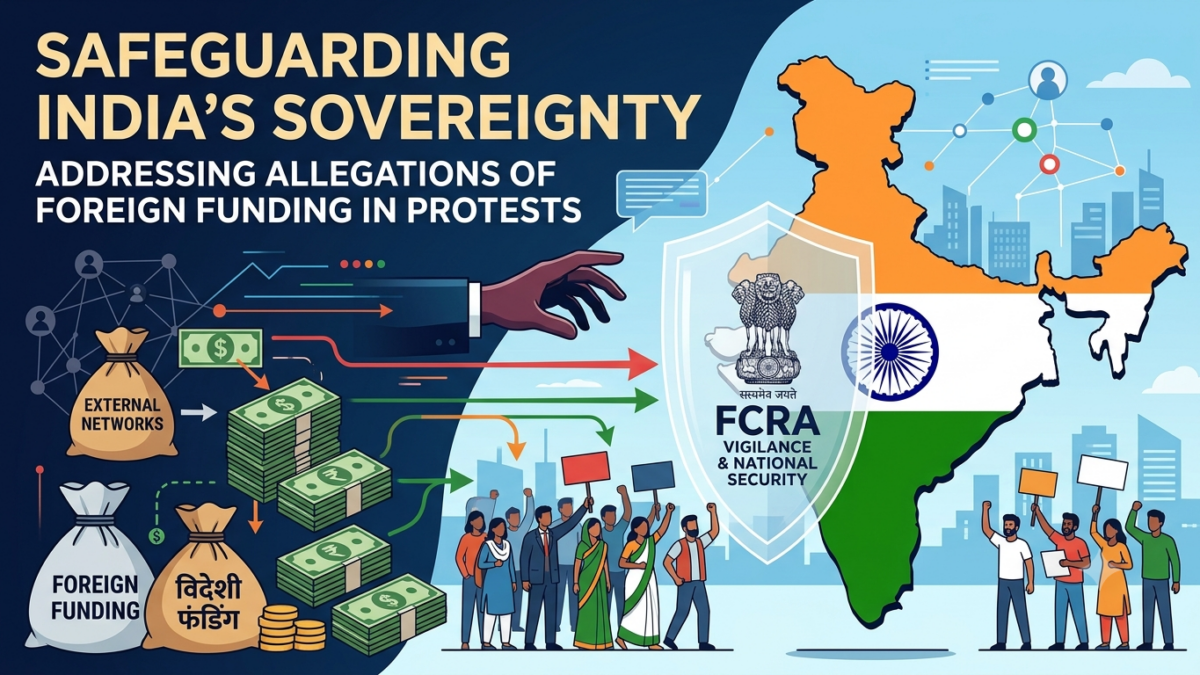
In an era defined by hyper-connectivity and global digital networks, the lines between organic domestic dissent and externally orchestrated civil unrest have become increasingly blurred. Recent debates in India have cast a sharp spotlight on the financial lifelines supporting various street agitations and political movements, with prominent legal minds and policymakers raising serious questions about the role of foreign funding—particularly from networks based in the United States.
As discussions intensify around national security, transparency, and democratic integrity, the imperative to protect India’s sovereignty from external manipulation has taken center stage.
The Economics of Unrest: Following the Financial Trail
Organizing large-scale protests, digital campaigns, and sustained civil disruptions is no small logistical feat. It requires robust infrastructure, continuous media coordination, and substantial capital.
Public figures, including former Solicitor General Harish Salve, have publicly voiced skepticism regarding the authenticity of certain demonstrations, questioning how seemingly localized movements secure the deep pockets necessary to sustain high-profile campaigns, international lobbying, and digital blitzes. When protests mirror patterns seen across geopolitical fault lines elsewhere in the world, critics argue that it is naive to view them purely as grassroots phenomena. Instead, analysts suggest that transnational networks and foreign interests often exploit local grievances to serve broader strategic objectives.
The Role of Regulatory Frameworks: Protecting National Security
At the heart of this debate lies the critical function of regulatory mechanisms like India’s Foreign Contribution Regulation Act (FCRA). Managing the largest ecosystem of non-governmental organizations (NGOs) in the world makes oversight not just a bureaucratic formality, but a vital matter of national security.
- Preventing Covert Interference: Foreign entities seeking to influence domestic policy or steer public opinion often channel funds through opaque networks of think tanks, advocacy groups, and digital activists.
- Ensuring Accountability: Strict enforcement of financial transparency ensures that civic engagement remains genuinely indigenous, accountable to Indian citizens, and free from external proxy agendas.
Lawmakers and security experts have consistently maintained that while peaceful dissent is a cornerstone of a healthy democracy, funneling foreign capital to manufacture artificial crises or destabilize elected governance crosses a dangerous red line.
Preserving Democratic Autonomy
India’s democratic fabric has weathered decades of complex challenges through domestic debate, judicial review, and electoral participation. Proponents of national sovereignty argue that importing foreign models of confrontation—backed by external donors who bear no stake in India’s collective future—only serves to polarize society and derail developmental momentum.
As public awareness grows regarding the mechanics of transnational influence, calls for a rigorous crackdown on illicit financial flows have gained momentum. True patriotism requires that domestic issues be addressed through indigenous dialogue, adhering strictly to the rule of law rather than yielding to external pressures.
Conclusion
India stands at a crucial juncture of economic growth and global leadership. Protecting the nation from external interference is not about silencing legitimate domestic voices, but about defending the sanctity of India’s democratic institutions against outside exploitation. By enforcing strict financial transparency, bolstering regulatory oversight, and remaining vigilant against foreign-backed disruptions, India can ensure that its democratic journey continues to be shaped solely by the aspirations of its own people.