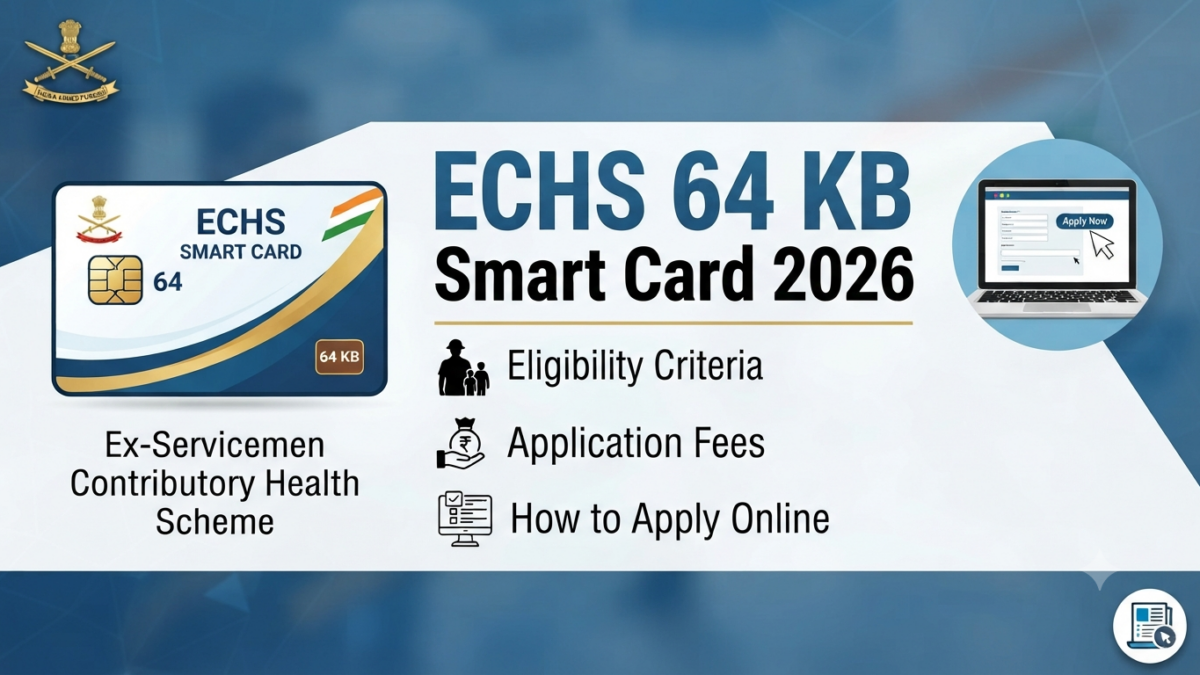
Every ECHS beneficiary now needs a 64 KB smart card; the old 16 KB and 32 KB cards are no longer valid. You apply online at the ECHS smart card portal, your Record Office verifies the application, and the card is sent to your Station HQ or parent polyclinic for collection. This guide covers who qualifies, what it costs, which documents to scan, how to track your application and how to fix common rejections.
Quick facts
| Item | Detail |
|---|---|
| Scheme | Ex-Servicemen Contributory Health Scheme (ECHS), Ministry of Defence |
| Card | 64 KB smart card, one per beneficiary |
| Where to apply | echs.sourceinfosys.com |
| One-time contribution | ₹30,000 to ₹1,20,000, by rank |
| Exempt from contribution | War widows, battle casualties, pre-1996 retirees |
| Card fee | Small per-card fee, paid online (amount shown at payment) |
| Who verifies | Your Record Office |
| Where you collect it | Parent polyclinic / Station HQ (no home delivery) |
| Helpline | 1800-114-115 (toll-free) or 011-25682870, 9 am to 5 pm |
Contents: What the card is · Eligibility · Contribution fees · Documents · How to apply · Status and timelines · Observations · Lost card · FAQs
What is the ECHS 64 KB smart card?
The 64 KB smart card is the identity card that lets an ex-serviceman and each eligible dependent take treatment at ECHS polyclinics and empanelled hospitals. It replaced the earlier 16 KB and 32 KB cards, which are no longer accepted.
Also read:Medical College Holds Workshop on Cadaveric Organ Retrieval and Kidney Preparation
Each family member gets a separate card. You need it for polyclinic visits, referrals to empanelled hospitals and online claims on the ECHS BPA portal. Card printing resumed on 7 January 2025 after a pause, so pending applications from that period are now being processed.
The card is not mailed to your home. Once verified, it goes to your Station HQ or parent polyclinic, where you collect it in person.
Who is eligible for an ECHS card?
The primary member must be an ex-serviceman drawing pension from the Controller of Defence Accounts, including disability and family pensioners. Dependents must already be recorded in the pensioner’s service records. Except for the spouse, each dependent needs income below ₹9,000 per month from all sources, excluding DA.
Short Service Commissioned Officers and pre-mature retirees are a special case: ECHS covers only the officer and spouse, not other dependents.
| Family member | Eligible until | Key condition |
|---|---|---|
| Spouse | Lifelong | No income limit; remarriage ends eligibility (except war widows) |
| Son | Earns, marries or turns 25, whichever is first | Unemployed and dependent |
| Unmarried daughter | Earns or marries, no age limit | Unemployed and dependent |
| Divorced, separated or widowed daughter | Lifelong, while conditions hold | Dependent; income limit applies |
| Step or legally adopted children | Same as natural children | Recorded as dependents in service records |
| Disabled son or daughter | Lifelong | Disability covered under the PwD Act 2016; issued a white card |
| Parents | Lifelong, while conditions hold | Normally live with the ESM; combined income under the limit; stepparents not covered |
| Sister | No age limit | Unmarried, divorced, separated or widowed; dependent; income limit applies |
| Minor brother | Until 18 | Dependent |
| Disabled brother | Lifelong | Permanently disabled, unmarried, wholly dependent, living with the ESM |
| Minor children of a widowed or separated daughter | Until 18 | Dependent and living with the ESM |
Annual validation of dependents
Under a July 2022 ECHS order, the primary member must re-confirm each dependent’s eligibility every year online. This means uploading a life certificate and income proof (PAN or an income certificate from the state revenue department). The parent polyclinic OIC approves it. If you skip it, the dependent’s card can be deactivated.
A dependent dropped for crossing the income limit can reapply once income has stayed below ₹9,000 (excluding DA) for two consecutive years.
ECHS contribution fees and ward entitlement
ECHS membership is a one-time contribution, normally paid at retirement, from ₹30,000 to ₹1,20,000 depending on rank. War widows, battle casualties and those who retired before 1996 are exempt. The rates below have applied since 29 December 2019.
| Rank category | One-time contribution | Hospital ward |
|---|---|---|
| Recruit to Havildar (and Navy/Air Force equivalents) | ₹30,000 | General |
| Naib Subedar to Subedar Major and equivalents, including Honorary Naib Subedar, MACP Naib Subedar and Honorary Lt/Capt | ₹67,000 | Semi-private |
| All officers | ₹1,20,000 | Private |
Separately, there is a small fee for each smart card, paid online when you submit the application. The exact amount is shown on the payment screen. If you add a dependent later, you pay for that card too.
Documents needed for the ECHS card application
Blurry or mismatched documents are the most common reason an application gets an observation. Scan everything clearly before you start, and check that every name matches your PPO and discharge book exactly.
Everyone needs:
- Photo and signature of every beneficiary
- PPO (Pension Payment Order) copy
- Aadhaar number for the ESM and each dependent
- Income proof for adult dependents: PAN, Form 26AS or an income certificate
Depending on your case:
- Old 16 KB or 32 KB card, or offline temporary slip, if you are upgrading
- Death certificate of the ESM, for a family pensioner
- Disability certificate, for a dependent covered under the PwD Act
- Certificate from your bank or DPDO that you are not drawing Fixed Medical Allowance (FMA), for first-time applicants who retired before 2003
- Receipt of the one-time contribution, for first-time applicants who retired between 1996 and 2003
A few practical points. No affidavit is needed; you accept a self-declaration inside the online form. Aadhaar is not mandatory for residents of the North East, Jammu and Kashmir or for Nepal-domiciled Gorkhas. A minor dependent can use the primary member’s mobile number and email. Also keep your old card’s Reg No. handy: that is the card number the form asks for, not the Sr No.
How to apply for the ECHS card online: step by step
The whole application is done on the ECHS smart card portal. Official instructions are on echs.gov.in under the online smart card application link.
Step 1: Register on the portal
- Open echs.sourceinfosys.com and choose the option for a new application.
- Select your category carefully (for example, ESM pensioner, family pensioner or old card holder).
- Enter your service number, name as on the PPO and mobile number, then verify with the OTP.
Step 2: Fill in the primary beneficiary’s details
- Log in and enter service, retirement, pension and bank details.
- Choose your parent polyclinic. Your card will be sent to the Station HQ for that area.
Step 3: Add each dependent
- Add one entry per eligible family member.
- Spell every name exactly as in the PPO and discharge book. A mismatch is the fastest way to get an observation.
Step 4: Upload documents
- Attach the photo, signature and ID for each person.
- Attach the PPO and discharge book pages to the primary member’s profile.
Step 5: Declare, pay and submit
- Accept the self-declaration that each dependent meets the eligibility conditions.
- Pay the card fee online (UPI, net banking or card).
- Submit. There is no hard copy to send anywhere; the application moves only online.
Finish and pay within 15 days of registering. Incomplete, unpaid applications are deleted automatically after that, and you would have to register again. The portal does not work in Internet Explorer; use Chrome, Firefox or Edge.
How to check ECHS card status, and how long it takes
Log in to echs.sourceinfosys.com and open your application’s audit trail to see where it stands. You can also check card status in the ECHS mobile app.
Your application moves through these stages:
- Awaiting verification by Record Office. Your own Record Office, not ECHS headquarters, checks the application against your service records. This is where most applications wait longest.
- Verified: temporary slip available. After verification you can download the temporary slip. Get it countersigned by the OIC of your parent polyclinic and use it for treatment until the card arrives. It is valid for three months at a time, and the OIC can extend it if the card is delayed.
- Printed and dispatched. The card goes to your parent polyclinic or Station HQ, not to your home.
- Ready for collection. The primary beneficiary gets an SMS with an OTP on the registered mobile number. Collect the card in person with the OTP and your old card, if any. The card must be activated at the polyclinic before first use.
ECHS does not publish a fixed processing time; it depends mostly on your Record Office’s workload and on whether an observation is raised. If it seems stuck:
- Still awaiting verification: contact your Record Office. Their numbers are listed on echs.gov.in.
- Verified but not printed: call 1800-114-115 or 011-25682870, or email jditechs1@echs.gov.in.
- Need to correct something: you can edit the application yourself before the Record Office verifies it. After verification, revert the application first; this must be done before the card is printed.
Observation raised? Common mistakes and how to fix them
An observation means the verifying office found a problem and sent the application back. Fix it on the portal and resubmit; you don’t need to start over.
| Problem | Fix |
|---|---|
| Name differs between PPO and Aadhaar (e.g. surname changed after marriage) | Upload supporting proof such as a marriage certificate or gazette notification |
| Dependent not in discharge book | Get Part II orders or the Record Office to update service records first |
| Unreadable PPO or photo | Rescan in good light; a flatbed scan is safest |
| Wrong category selected at registration | Contact the helpline or your polyclinic; category drives which documents are checked |
| Dependent income proof missing | Upload PAN, Form 26AS or an income certificate for each adult dependent |
Lost or damaged ECHS card
Log in to echs.sourceinfosys.com, block the lost 64 KB card under the loss-of-card option, pay online and mark it for reprint. The new card is sent to your parent polyclinic. Meanwhile, download a temporary slip and get it countersigned by any polyclinic OIC so treatment continues.
If details on your card are wrong (name, date of birth, entitlement), use the change-of-data option on the same portal. The corrected application goes back to your Record Office for verification before reprinting.
ECHS card FAQs
Can I use the temporary slip in an emergency?
Yes, once it is countersigned by your parent polyclinic’s OIC and still within its validity period.
Is the ECHS card delivered to my home?
No. It is dispatched to your Station HQ or parent polyclinic, and you collect it in person.
Are adopted children covered?
Yes. Stepchildren and legally adopted children are covered on the same terms as natural children, provided they are recorded as dependents in your service records.
Do I need to renew the ECHS card every year?
The primary member’s card does not need annual renewal, but dependents’ eligibility must be validated online every year. Skipping it can get a dependent’s card disabled.
What is the ECHS income limit for dependents?
₹9,000 per month from all sources, excluding DA. For parents, the limit applies to their combined income.
Who do I contact for help?
Call 1800-114-115 (toll-free) or 011-25682870 between 9 am and 5 pm. For card issues you can also email jditechs1@echs.gov.in, or visit your parent polyclinic.
Can I change my parent polyclinic?
Yes, online through the same portal, once every three months. This helps if you move or spend long periods in another city.
Official sources
- ECHS official website
- ECHS FAQs (Central Organisation ECHS, April 2023)
- ECHS smart card application portal
- Annual validation of dependents, ECHS order of 6 July 2022 (https://www.gconnect.in/defence-services/echs/annual-validation-echs-membership-dependent-submission-life-certificate.html)